
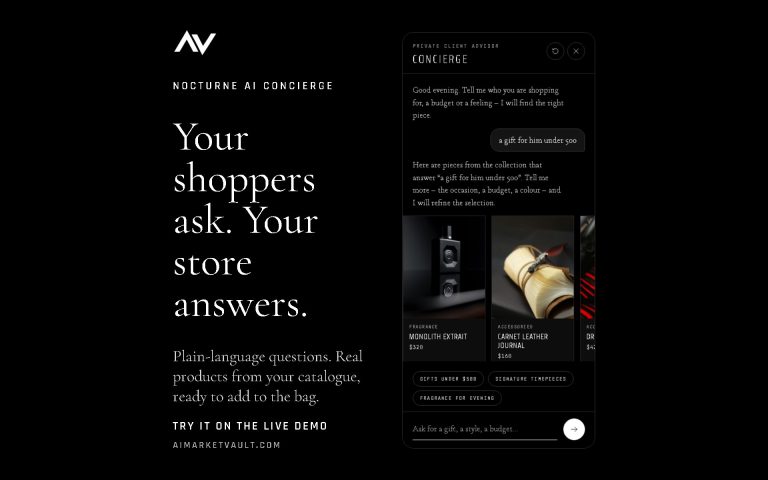
Shoppers increasingly type questions, not keywords: “a gift for a coffee lover under $50” or “will this sofa fit a small flat?”. Keyword search struggles with that. Retrieval-augmented generation (RAG) lets your site search and chat understand the question and answer from your real products, prices and policies instead of guessing.
How RAG works, in four steps
- Index: product titles, descriptions, attributes, FAQs and policies are split into passages.
- Embed: an embedding model turns each passage into a vector that captures its meaning.
- Retrieve: when a shopper asks something, their question is embedded too, and a vector database such as Qdrant finds the most relevant passages, filtered by stock, price or category.
- Answer: a language model writes a reply using only those passages, with links to the actual products.
Why it beats keyword search
Vector search matches meaning, so “something warm for winter evenings” can find a wool throw that never uses the word warm. Combining it with keyword search (hybrid search) keeps exact matches such as SKUs and brand names accurate.
Why grounding matters
A chatbot without retrieval invents products and prices. Grounding every answer in retrieved passages, and refusing when nothing relevant is found, keeps answers accurate. This is what makes a catalogue-grounded AI shopping concierge trustworthy.
What to index first
- Product data: titles, descriptions, attributes, variations, price and stock.
- Buying help: size guides, care instructions, compatibility notes.
- Policies: shipping, returns, warranties and payment options.
Keeping it fresh
Re-index when products change, not on a monthly schedule. Stock and price filters should come from live data so the assistant never recommends something you cannot sell.
Build or buy
You can assemble RAG from open components: an embedding model, Qdrant and an LLM. If you would rather have it run for you, our managed vector search & RAG provides the Qdrant database and embedding pipeline, and the AI website concierge puts it in front of shoppers by text or voice.
Frequently asked questions
What is RAG in ecommerce?
Retrieval-augmented generation: search and chat that first retrieve relevant products and policies from your own data, then answer using only that information.
Do I need a vector database for RAG?
For more than a few hundred items, yes. A vector database such as Qdrant stores embeddings and finds the closest matches quickly, with filters for stock and price.
Will RAG replace my existing site search?
It usually works alongside it. Hybrid search combines meaning-based and keyword results, so exact SKUs and brand names still match precisely.


Comments